Recently, a new review paper titled "The Role of Urban Green Spaces in Mitigating the Urban Heat Island Effect: A Systematic Review from the Perspective of Types and Mechanisms" has been published in the renowned SCI journal "Sustainability" (with an impact factor of 3.9 and ranking in JCR Q2).
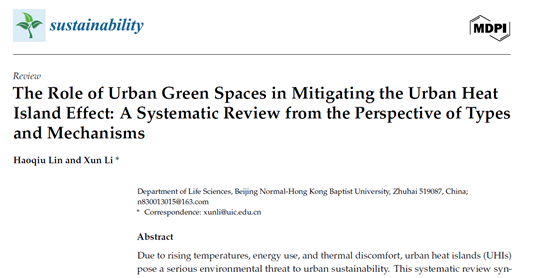
This paper systematically reviews the mechanisms and characteristic types of urban green spaces in mitigating the heat island effect, focusing on analyzing the core cooling pathways such as shading, evapotranspiration, reflectivity regulation, and ventilation. It also assesses the applicability and efficacy of various green space forms like parks, green roofs, and street trees in different urban environments. The research provides empirical-based green space configuration strategies for urban planners and policy makers, and holds significant reference value for enhancing urban climate adaptability and the sustainability of human living environments.

The corresponding author of this paper is Dr. LI Xun, an assistant professor from the Environmental Science Programme (ENVS) at the Faculty of Science and Technology of Beijing Normal- Hong Kong Baptist University (BNBU). Dr. LI Xun's research fields include environmental economics, landscape ecology, sustainable development, spatial modeling, remote sensing, geographic information science, etc. Since joining BNBU, he has been teaching the ENVS major course "Introduction to Geographic Information Systems for Environmental Management". Meanwhile, the first author of this paper, LIN Haoqiu, a graduate from Food Science and Engineering from the Department of Life Sciences, developed a strong interest in spatial analysis and environmental system research when he took this course. Subsequently, while studying for a Master's degree in Environmental Management at the University of Hong Kong, he maintained close scientific collaboration with Dr. LI Xun and jointly completed this research. This is a successful demonstration of the cultivation path of ENVS, which "stimulates scientific research interest through courses and continues academic growth through cooperation".
All along, ENVS has been providing students with multiple levels of academic development channels through continuous curriculum construction, scientific research training and cross-university cooperation. The professional education not only solidifies students' academic foundation but also helps them establish a continuous research influence in the field of sustainable development through forward-looking scientific research guidance and cooperation mechanisms.
Text and Photo by: LI Xun
Translated by: Youdao Translator, HE Shimei
Edited by: HE Shimei
Reviewed by: Siu-tai TSIM